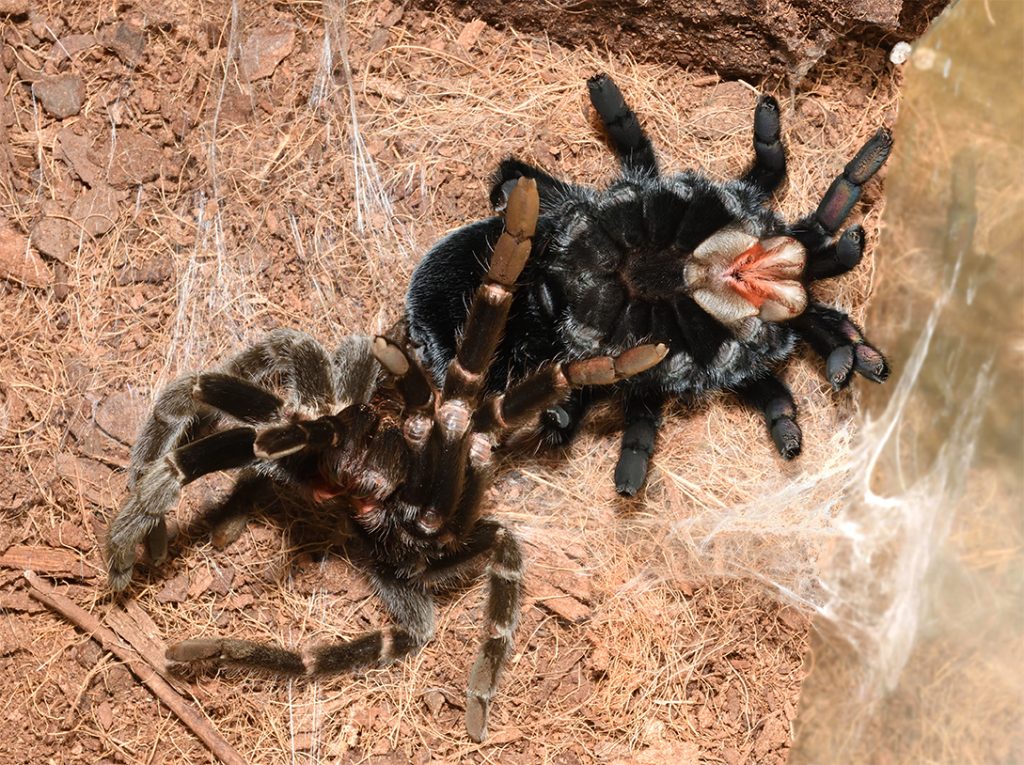
In arthropods, such as insects, arachnids, myriapods and crustaceans, molting is the shedding of the exoskeleton, typically to let the organism grow. This process is called ecdysis. Most Arthropoda with soft, flexible skins also undergo ecdysis. Ecdysis permits metamorphosis, the sometimes-radical difference between the morphology of successive instars. A new skin can replace structures, such as by providing new external lenses for eyes. The new exoskeleton is initially soft but hardens after the molting of the old exoskeleton. The old exoskeleton is called exuviae. The Latin word exuviae, meaning „things stripped from a body”, is found only in the plural. Exuvia is a derived singular form, although this is a neologism, and not attested in texts by Roman authors.
After molting, an arthropod is „fresh”, pale and soft-bodied. Within one or two hours, the cuticle hardens and darkens. During this short phase the animal expands, since growth is otherwise constrained by the rigidity of the exoskeleton. Growth of the limbs and other parts normally covered by the hard exoskeleton is achieved by transfer of body fluids from soft parts before the new skin hardens. Ecdysis allows damaged tissue and missing limbs to be regenerated or substantially re-formed. Complete regeneration may require a series of molts, the stump becoming a little larger with each molt until the limb is a normal, or near normal, size.
The process
In preparation for ecdysis, the arthropod becomes inactive for a period, undergoing apolysis or separation of the old exoskeleton from the underlying epidermal cells.
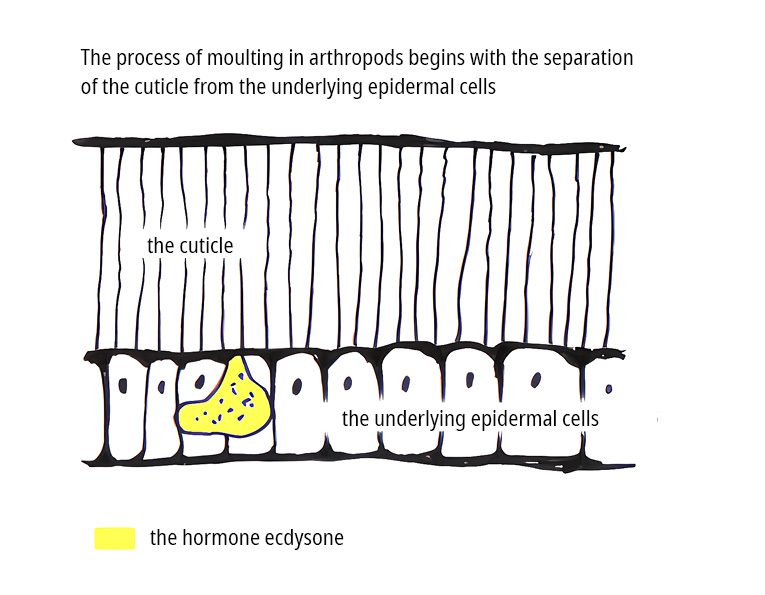
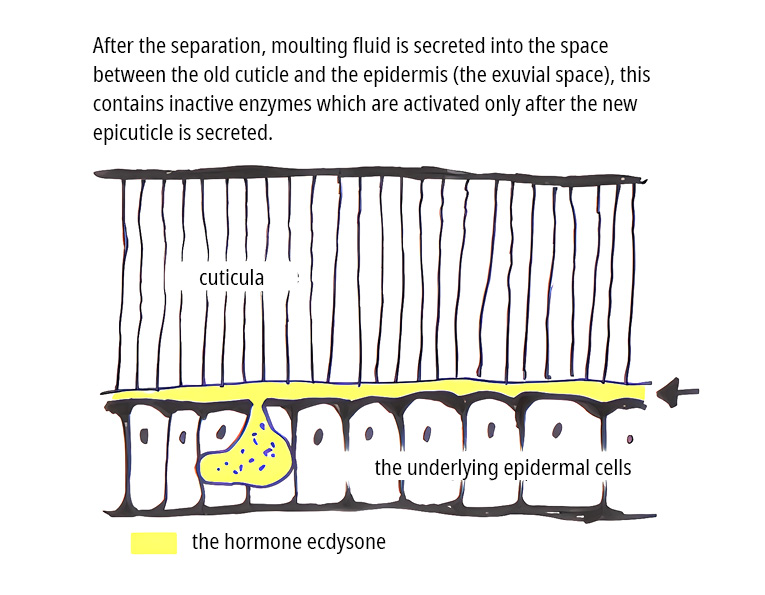
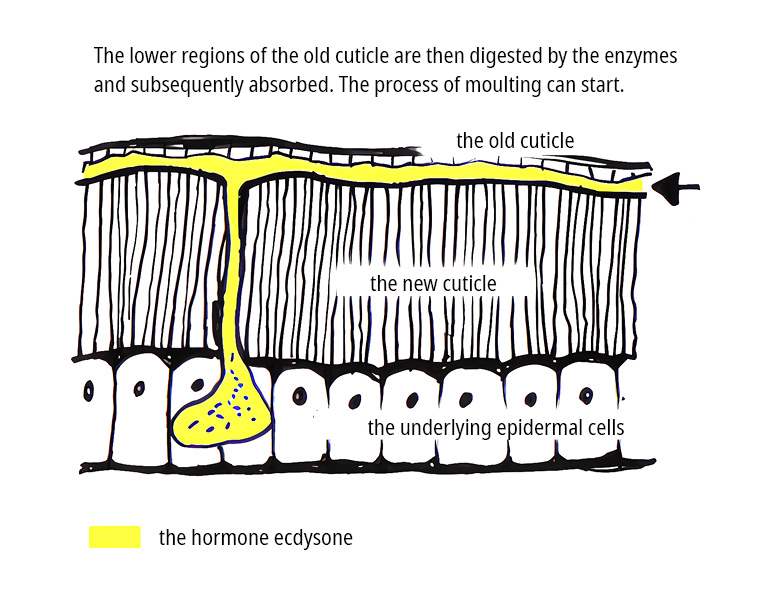
For most organisms, the resting period is a stage of preparation during which the secretion of fluid from the molting glands of the epidermal layer and the loosening of the underpart of the cuticle occurs. Once the old cuticle has separated from the epidermis, a digesting fluid is secreted into the space between them. This fluid remains inactive until the upper part of the new cuticle has been formed. Then, by crawling movements, the organism pushes forward in the old integumentary shell, which splits down the back allowing the animal to emerge. Often, this initial crack is caused by a combination of movement and increase in pressure of hemolymph within the body, forcing an expansion across its exoskeleton, leading to an eventual crack that allows for certain organisms such as spiders to extricate themselves. While the old cuticle is being digested, the new layer is secreted.
Arachnids (spiders, scorpions, ticks, mites, etc.) molt regularly to grow, often becoming reclusive prior to a molt. Spiders generally change their skin for the first time while still inside the egg sac, and the spiderling that emerges broadly resembles the adult. The number of molts varies, both between species and sexes, but generally will be between five times and nine times before the spider reaches maturity. Not surprisingly, since males are generally smaller than females, the males of many species mature faster and do not undergo ecdysis as many times as the females before maturing.
Spiders stop feeding at some time before molting, usually for several days. The physiological processes of releasing the old exoskeleton from the tissues beneath typically cause various colour changes, such as darkening. Contact between the nerves and the old exoskeleton is maintained until a very late stage in the process. The new, teneral exoskeleton must accommodate a larger frame than the previous instar, while the spider has had to fit into the previous exoskeleton until it has been shed. This means the spider does not fill out the new exoskeleton completely, so it commonly appears somewhat wrinkled.
A young tarantula may do this several times a year as a part of the maturation process, while full-grown specimens only molt once a year, or sooner, to replace lost limbs or lost urticating hairs. It is visibly apparent that molting is imminent when the exoskeleton takes on a darker shade. If a tarantula previously used its urticating hairs, the bald patch turns from a peach color to deep blue. During the molting process the tarantula first lays for hours motionless on its back, as if it were dead. To open the old exoskeleton, the spider contracts its abdomen (opisthosoma) to supply enough fluid to pump into the prosoma with sufficient pressure to crack it open along its lines of weakness. The carapace lifts off from the front, like a helmet, as its surrounding skin ruptures, but it remains attached at the back, and then the spider works its limbs free. At this point the spider is teneral and vulnerable. Subsequently, its exoskeleton hardens and takes shape, and this process may take hours in the larger Mygalomorphs. Even its fangs, the hardest part of its body, are soft at first, so the spider is unable to feed until they harden.