
TARANTULAS are a group of large and hairy spiders of the family Theraphosidae. More than a thousand species have been identified, within almost 200 genera, yet also other members of the same infraorder (Mygalomorphae) are commonly referred to as „tarantulas” or „false tarantulas”. Some of the more common species have become popular in the exotic pet trade.
Like all arthropods, the tarantula relies on an exoskeleton for support of muscles and internal organs. Like other Arachnida, a tarantula’s body comprises two main parts, the prosoma (or cephalothorax) and the opisthosoma (or abdomen). The prosoma and opisthosoma are connected by the pedicel. This waist-like connecting piece is part of the prosoma and gives the opisthosoma a wide range of motion relative to the prosoma.
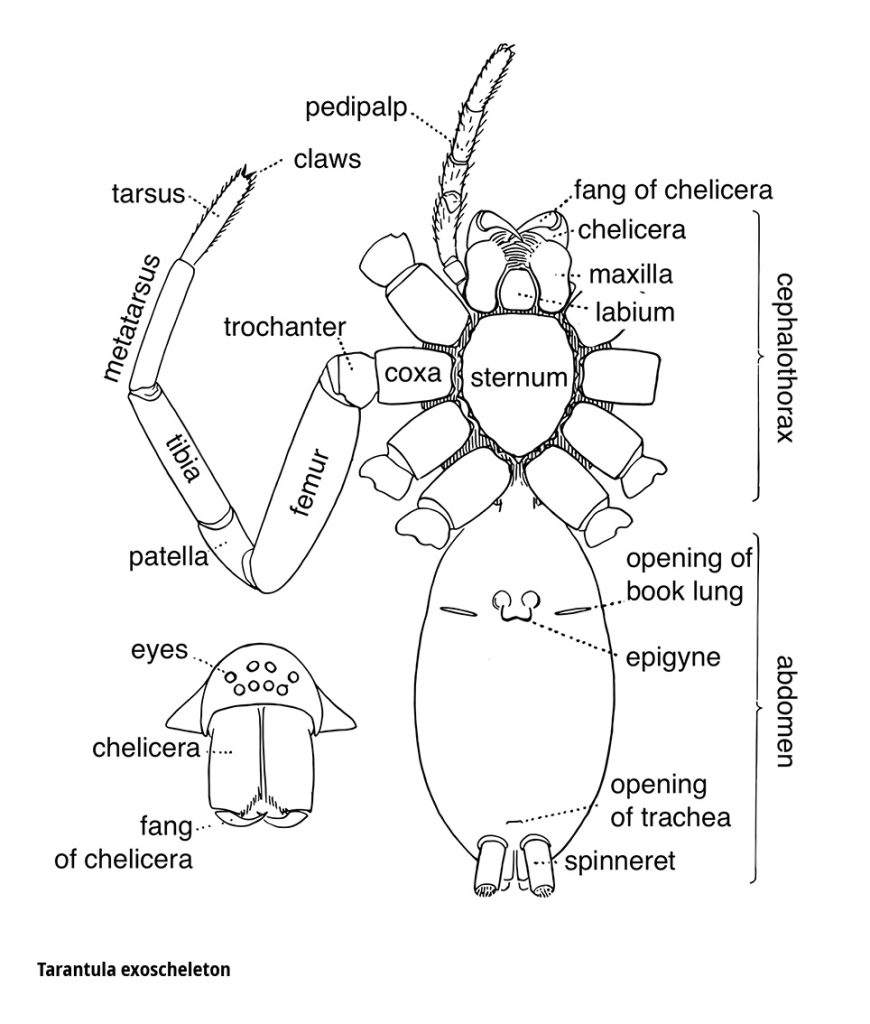
Depending on the species, the body length of tarantulas ranges from about 5 to 11 cm with leg spans of 8–30 cm. (leg span is determined by measuring from the tip of the back leg to the tip of the front leg on the opposite side). The largest species may weigh over 85 g; the largest of all, the Goliath bird eater (Theraphosa blondi) from Venezuela and Brazil, attains a weight of 170 g and a leg-span up to 30 cm, males being longer and females greater in girth. The fang size of this tarantula reaches a maximum of 4 cm.
Their natural habitats include savanna, grassland (such as in the pampas), rainforest, desert, scrubland, and mountains. They are generally terrestrial types and are burrowers that live in the ground. Tarantulas do not use their webs for hunting, but as building material or tripwire. Tarantula fangs face downward, as opposed to those of true spiders, which face each other. They also have two book lungs, as opposed to true spiders, which only have one. Their lifespan is also longer than in most spiders.
The spider originally bearing the name “tarantula” was Lycosa tarantula, a species of wolf spider (Lycosidae) native to Mediterranean Europe. The name is derived from the southern Italian town of Taranto and provided the name of the Italian folk dance tarantella (originally either a form of collective hysteria, a folk medicine remedy, or a remnant of ancient Dionysian dances). The term tarantula was subsequently applied to almost any large species of ground-dwelling spider: to the Mygalomorphae infraorder and especially the New World Theraphosidae. Wolf spiders are not particularly large or hairy, and so among English speakers in particular, usage eventually shifted in favour of the Theraphosidae, even though they belong to a different infraorder. The name “tarantula” is also applied to other large-bodied spiders, including to other families belonging to infraorder Mygalomorphae or even to infraorder Araneomorphae.
Tarantulas of various species occur throughout the United States, Mexico, Central America, and throughout South America. Other species occur variously throughout regions of Africa, much of Asia (including southern Japan), and all of Australia. In Europe, some species occur in Spain, Portugal, Turkey, southern Italy, and Cyprus.
Some genera of tarantulas hunt prey primarily in trees; others hunt on or near the ground. All tarantulas can produce silk; while arboreal species typically reside in a silken „tube tent”, terrestrial species line their burrows with silk to stabilize the burrow wall and facilitate climbing up and down. Tarantulas mainly eat large insects and other arthropods (such as centipedes, millipedes, and other spiders), using ambush as their primary method of prey capture. The biggest tarantulas sometimes kill and consume small vertebrates such as lizards, mice, bats, birds, and small snakes.
Besides the normal bristles covering the body, most New World species have SPECIALIZED BRISTLES, or setae, on the opisthosoma, to defend themselves against predators. These urticating hairs are usually kicked off the abdomen by the tarantulas by using their back pairs of legs, but some may simply rub the abdomen against the “target”. These fine bristles are barbed and can be lethal to small animals such as rodents. Some people are sensitive to these bristles and develop serious itching and rashes at the site. Exposure of the eyes and respiratory system to urticating hairs should be strictly avoided. Species with urticating hairs can kick these bristles off; they are flicked into the air at a target. Tarantulas also use these bristles for other purposes, such as to mark territory or to line their shelters. Urticating hairs do not grow back but are replaced with each molt.
To predators and other enemies, these bristles can range from being lethal to simply being a deterrent. With humans, they can cause irritation to eyes, nose, and skin, and more dangerously, the lungs and airways, if inhaled. In some cases, tarantula bristles have caused permanent damage to human eyes. Some setae on the chelicerae are used to stridulate, more common in Old World species, making a hissing sound.
All tarantulas are venomous. Although their VENOM is not deadly to humans, some bites cause serious discomfort that might persist for several days. In general, the effects of the bites of all species of tarantula are not well known. While the bites of many species are known to be no worse than a wasp sting, the bites by some species are very painful and produce spasms that may recur over a period of several days; the venom of the African tarantula Pelinobius muticus causes strong hallucinations. For Poecilotheria species, bites cause severe and diffuse muscle cramps, lasting for several days. In all cases, seeking medical aid is advised. Because other proteins are included when a toxin is injected, some individuals may suffer severe symptoms due to an allergic reaction rather than to the venom. Such allergic effects can be life-threatening. Additionally, the large fangs of a tarantula can inflict painful puncture wounds, which can lead to secondary bacterial infections if not properly treated.
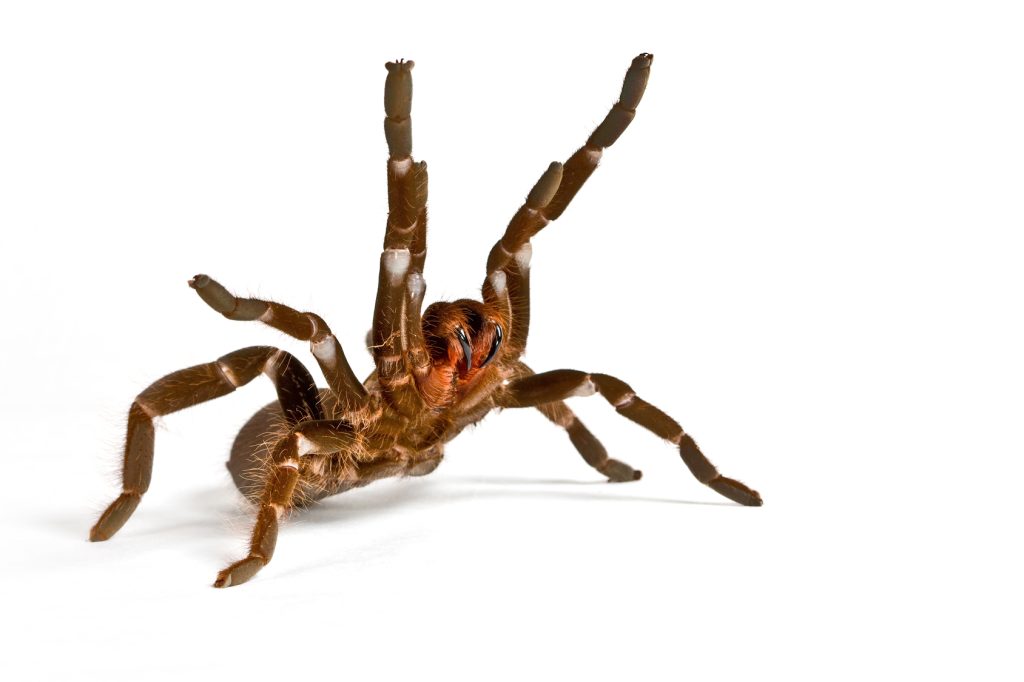
Before biting, a tarantula may signal its intention to attack by rearing up into a „threat posture”, which may involve raising its prosoma and lifting its front legs into the air, spreading and extending its fangs, and (in certain species) making a loud hissing by stridulating. Their next step without biting may be to slap down on the intruder with their raised front legs. If that fails to deter the attacker, the tarantulas of the Americas may next flick urticating hairs. The next response may be to flee, but especially if no line of retreat is available, their final response may be to bite. Some tarantulas give „dry bites”, i.e., they may bite some animal that intrudes on their space, but they do not pump venom into the wound. The Goliath bird eater is known for its particularly irritating urticating bristles. They can penetrate the cornea, so eye protection should be worn when handling such tarantulas.
Old World tarantulas have no urticating bristles and are more likely to attack when disturbed. They often have more potent, medically significant venom, and are faster and much more nervous and defensive than New World species.